Jacob Tutt
Astrophysics PhD Candidate
Radio Astronomy and Cosmology
Kavli Institute for Cosmology
Cavendish Laboratory, University of Cambridge

Battcock Centre
Cavendish Laboratory
JJ Thomson Avenue
Cambridge, UK - CB3 0HE
I am a second-year PhD candidate in the Cavendish Radio Astronomy and Cosmology Group at the Kavli Institute for Cosmology, University of Cambridge, funded by the Harding Distinguished Scholars Programme. My research looks at how the latest statistical and probabilistic machine learning methods, combined with distributed, hardware-accelerated computing, can tackle previously intractable inference problems in physics.
My work is centred on answering questions about cosmic dawn and reionisation, one of cosmology’s last observational frontiers. When did the first stars form, and what were they like? How did the first galaxies and black holes heat and ionise the hydrogen around them? And how did the Universe go from dark and neutral to the ionised, galaxy-filled cosmos we see today?
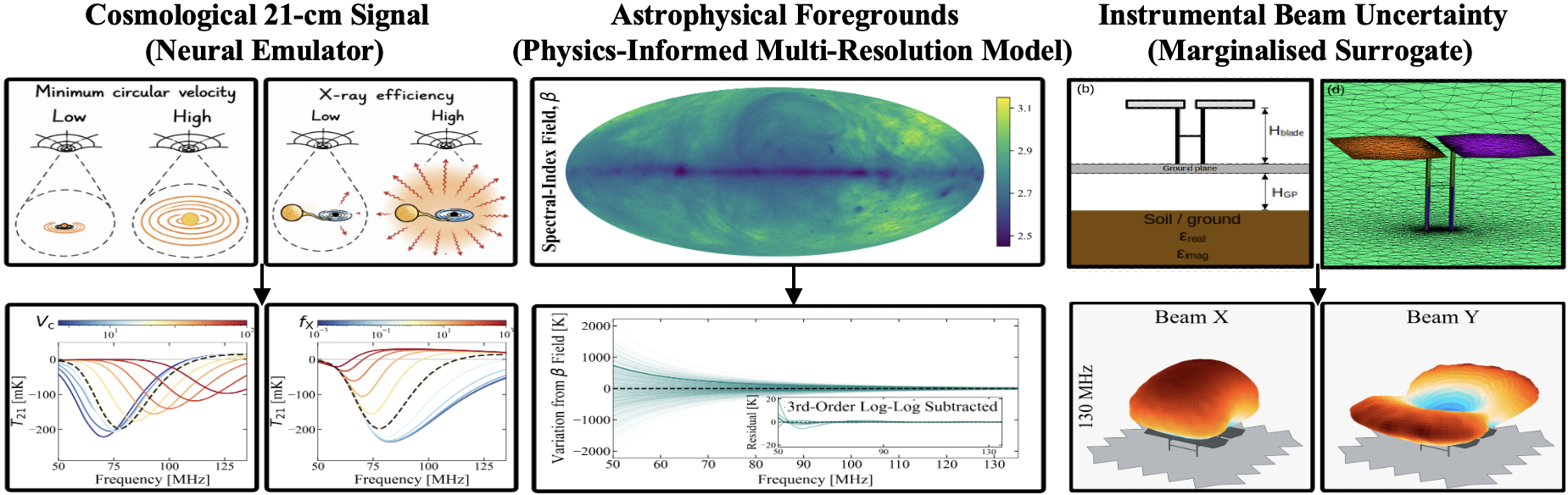
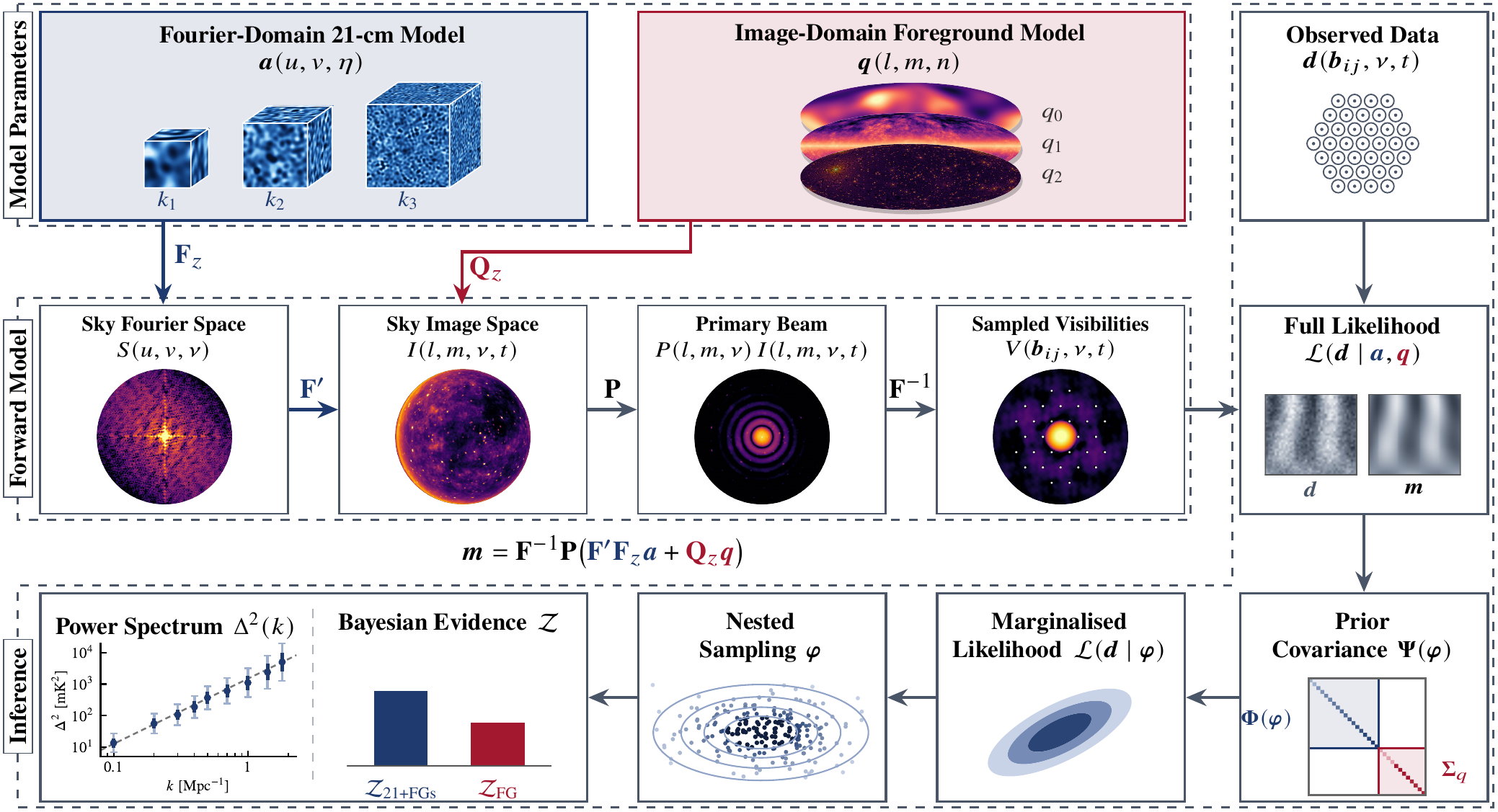
The 21-cm hyperfine transition of neutral hydrogen offers a direct window onto this era; however, detecting it is a notoriously difficult inference challenge for both global 21-cm experiments such as REACH and interferometric arrays such as the upcoming Square Kilometre Array Observatory. In both cases, the signal lies buried beneath foregrounds many orders of magnitude brighter and is distorted by the complex electromagnetic response of the instrument, making its detection acutely sensitive to model misspecification. Tackling it requires both fast, accurate forward models and efficient methods to invert them. My work therefore develops physically motivated, differentiable and hardware-accelerated generative models that account for the relevant sources of uncertainty, spanning astrophysical simulations to computational electromagnetics. Alongside these, it also develops scalable inference methods that solve the resulting high-dimensional inverse problems with rigorous Bayesian uncertainty quantification. Ultimately, the aim is to extract the maximal scientific information from astronomical datasets, from broader cosmology to gravitational-wave astronomy. Beyond astrophysics, my interests lie more widely in scaling statistical and numerical methods across the sciences, both algorithmically and computationally, to ever larger datasets, parameter spaces and physical systems.
Before my PhD, I completed the MPhil in Data Intensive Science, jointly taught by the Department of Applied Mathematics and Theoretical Physics, the Department of Physics and the Institute of Astronomy. My work focused on developing unsupervised machine learning frameworks to study the assembly history of the Milky Way, alongside projects ranging from gravitational-wave cosmology to LoRA fine-tuning of transformers. I hold a BSc in Physics from Durham University, where I carried out research within the Institute for Computational Cosmology and the Centre for Extragalactic Astronomy.
Outside academia, I am passionate about endurance sports. I rowed competitively as part of Durham University’s British Rowing Programme and in 2024 completed the Great Norse Run: nine marathons in ten days across Iceland, raising over £21,000 for emergency services and armed forces mental health.
News
| Oct 02, 2025 | Joined the Radio Astronomy and Cosmology Group at the Cavendish Laboratory, University of Cambridge as a Astrophysics PhD Candidate under the supervision of Dr Eloy de Lera Acedo. |
|---|
Selected Papers
Selected Talks
- An Optimal Latent Space for Uncertainty Quantification and Evidence Evaluation in 21-cm CosmologyOct 202621-cm Meeting Series, University of Cambridge, UK
- GPU-Accelerated Bayesian Forward Models: Uncertainty Quantification for Global 21-cm CosmologySep 2026IX Global 21-cm Workshop, University of Malta, Valletta, Malta


